Most Popular Yiddish Song Ever? Rozhinkes Mit Mandlen (Goldfaden). Marc Berman, Vocals. (Translation in Video Description)
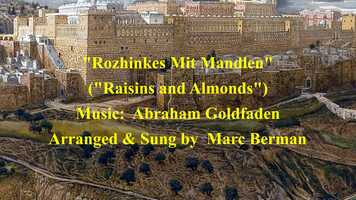
This is the free video Most Popular Yiddish Song Ever? Rozhinkes Mit Mandlen (Goldfaden). Marc Berman, Vocals. (Translation in Video Description) that can be downloaded, played and edit with our RedcoolMedia movie maker MovieStudio free video editor online and AudioStudio free audio editor online

VIDEO DESCRIPTION:
Play, download and edit the free video Most Popular Yiddish Song Ever? Rozhinkes Mit Mandlen (Goldfaden). Marc Berman, Vocals. (Translation in Video Description).
Originally from Abraham Goldfaden's musical '"Shulamith," the song "Rozhinkes Mit Mandlen" may be the most famous of all the Yiddish Songs. Indeed, it is among the most well-known examples of Yiddish Music or Jewish music in any genre.
Goldfaden wrote music that often was in a style similar to Chazzanut (cantorial music). "Rozhinkes Mit Mandlen" was no exception.
The song has been recorded by many of the greatest voices and musical artists, including Jan Peerce and Richard Tucker. On this video, a recording by contemporary artist and chazzan (cantor) Marc Berman is heard.
"Rozhinkes Mit Mandlen" was adapted by its composer from a popular Yiddish lullaby. Still, the piece is not just a lullaby, as it may seem to be on the surface.
Rather, "Rozhinkes Mit Mandlen" is a deeply symbolic work, reflecting the 2000-year-old aspirations of the Jewish people to return to their ancestral home in the land of Israel. Note the reference to the Temple in Jerusalem. Note further the protagonists' names: The mother is the widowed "Daughter of Zion," and her son's name literally means "Little Jew."
The idea being that when the messiah comes and all Jews return to Zion, life will be delicious, like eating raisins and almonds. (Before candy was produced on an industrial scale, raisins and almonds was a delicacy that satisfied children's' love of sweet foods.)
Abraham Goldfaden was the founder of the Yiddish theater. He was born at Alkonstantin, Russia, in 1840. In 1866, he graduated from the governmental rabbinical school of Zhitomir. He taught in government schools at Simferopol and Odessa. In 1875, Goldfaden went to Lemberg, and founded "Yisrolik," a humorous Yiddish weekly. The journal only lasted six months. Goldfaden then moved to Czernowitz. There he founded another journal, "Bukowiner Israelitisches Volksblatt," which also only lasted briefly.
Goldfaden's initial theatrical production was "The Recruits," staged in Iasi, Romania, in 1876. Goldfaden himself built the stage, painted the decorations, wrote the words, composed the music, and directed. In 1878 he established himself in Russia in the Maryinski Theater in Odessa. He conducted several very successful tours, but in 1883 was prohibited by the czarist regime from performing further . He spend several years in Rumania and Galicia and managed to restart his theatrical efforts briefly in Warsaw.
In 1887, Goldfaden traveled to the United States, living in New York. He founded a journal, "New Yorker Illustrirte Zeitung," which was the first the first Yiddish illustrated periodical.
Nonetheless, from a theatrical perspective, his first American sojourn was not a success. The impresarios of the recently-established Yiddish theaters in New York did not want competition from Goldfaden. Thus, they discouraged actors from working with him. Goldfaden left America in 1889, living thereafter mainly in Paris.
In 1903 he returned to New York. He died there in 1908, in poverty. As in the case of Mozart, composing great music apparently does not always pay the bills.
Goldfaden composed a volume of Hebrew poetry in 1865. However, as far as his literary efforts went, he was better known for his Yiddish poetry. He was even called called "the most Jewish" of all the Yiddish poets. He was also an early Zionist.
The songs from Goldfaden's popular plays were sung by the Yiddish-speaking Jews world-wide. Despite having no formal music education, he composed over 25 musical dramas. These include "Shulamith" "Bar Kochba," "Shmendrik," "Die Kishufmacherin" ("The Sorceress"), "Di Tzvei Kune Lemels," ("The Two Fools"), and "Dr. Almasada.
Goldfaden referred to his stage works as "operas" or "operettas." Certainly, the wide-ranging vocal demands that his songs (arias?) often exact from singers may be appropriately termed "operatic."
Many of Abraham Goldfaden's theatrical works were historical dramas that aimed not merely to entertain, but also to educate. He remains known as the "father of the Yiddish theater."
Here is a translation:
In the Holy Temple,
in a corner room,
the widow "Daughter of Zion" sits alone.
She rocks her only son "Yideleh" back and forth,
and sings him a lullaby to help him sleep:
"Under Yideleh's little crib
stands a totally white goat.
The goat has been sold in the market.
That is what you will do someday:
You will sell raisins and almonds.
Now please sleep, Yideleh."
"Under Yideleh's little crib
stands a totally white goat.
The goat has been sold in the market.
That is what you will do someday:
You will sell raisins and almonds.
Now please sleep, Yideleh."
[Required Legal Notice: I materially developed all videos posted by me on Vimeo. All videos feature my voice exclusively on the audio. The videos were created and edited ENTIRELY by me using audio and video editing software. All media in the video were either created by me, licensed by me, or are believed to be in the public domain.]
Download, play and edit free videos and free audios from Most Popular Yiddish Song Ever? Rozhinkes Mit Mandlen (Goldfaden). Marc Berman, Vocals. (Translation in Video Description) using RedcoolMedia.net web apps