Dance of Urgency
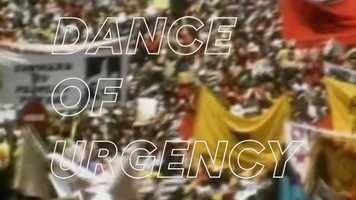
This is the video Dance of Urgency that can be downloaded, played and edit with our RedcoolMedia movie maker MovieStudio video editor online and AudioStudio audio editor online

VIDEO DESCRIPTION:
Play, download and edit the video Dance of Urgency.
Every type of dance is based on an underlying symbolism. Dance can be a form of socialising, an art form or an expression of ritualistic practices. How do the Rave-o-lution of 12 March 2018 in front of the Georgian Parliament in Tbilisi and anti-fascist protests in Berlin relate to ancient Dionysian rituals, and why does the soundtrack to these events come from the drums of African Americans? And to what extent does dance club culture reflect the current socio-political situation and the struggle of individuals or of groups? The exhibition, curated by Bogomir Doringer, aims to find a definition of 'Dance of Urgency' that is based on those emotions arising out of personal and collective crises.
Participants:Chiara Baldini (ITA), Jan Beddegenoodts (BEL), Irina Birger (NLD), Heather Dewey-Hagborg (USA), Shohei Fujimoto (JPN), Nikolaus Geyrhalter (AUT), Frédéric Gies (FRA), Kélina Gotman (GBR/CAN), Dan Halter (ZWE), Dimitri Hegemann / TRESOR (GER), Sampo Hänninen (FIN), Cornelius Harris & Mark Flash / UNDERGROUND RESISTANCE (USA), Andrew Herzog (USA), Damien Jalet (BEL/FRA), JAZAR CREW (PSE), Liese Kingma (NLD), Rafael Kozdron (POL), Yarema Malashchuk & Roman Himey / CXEMA (UKR), MAMBA NEGRA (BRA), Pedro Marum (PRT), Moniker (NLD), Naja Orashvili & Giorgi Kikonishvili / BASSIANI (GEO), Francesco Pusterla (ITA), RECLAIM CLUB CULTURE, Paata Sabelashvilli (GEO), Derek Sivers (USA), SPACEMAKER (NLD), Anna Vasof (AUT), Ari Versluis (NLD), Anne de Vries (NLD)
Memories of clubbing during the 1999 NATO strikes on Belgrade were the catalyst for Serb-Dutch artist and curator Bogomir Doringer (Ph.D. candidate, Artistic Research, University for Applied Arts Vienna) to focus on dance as a political phenomenon. In 2014 as part of the project 'I Dance Alone', Doringer began to document dance culture in clubs and variants of collective and individual forms of dance around the world.
In countries where the social system has broken down and cultural institutions are lacking, clubs serve as hubs where people meet, move, learn, but also where young people are influenced or manipulated. When clubs are understood to be places in which social changes are reflected, the examination of dance culture can help better predict and understand the behaviour of mass movements.
At the same time, Doringer addresses the return of political power on the dance floor, something which is becoming ever-more prevalent following the emergence of right-wing sentiment, particularly in the west. Authoritarian political systems foment the emergence of new ideas and movements. Thus Jazar Crew (Palestine), for example, as the star of the local electronic music scene, gives a face to Palestinian youth; Mamba Negra (Brazil) who focus on women and LGBTQ+ empowerment or the group Cxema (Ukraine), whose rave events are meeting places for various groups and communities of progressive youth.
When people congregate to dance together, they influence one another's movements through their physical and emotional bonds. In May 2018, government armed forces carried out a raid on the well-known Techno Club 'BASSIANI' in Tbilisi, Georgia. The club was known for its activist activities. The following day, 15,000 people flooded into the streets to protest against the raid, ultimately compelling the government to issue an official apology. 'We Dance Together, We Fight Together' was the most prominent slogan to be seen over those days. The experimental film 'Dance or Die' by Naja Orashvili and Giorgi Kikonishvili (BASSIANI) pursues the political importance of dance and shows how club spaces paved the way for a completely new youth culture in Georgia. The events in Tbilisi inspired other movements worldwide: not long afterward, 70,000 people met in Berlin to protest against fascism. The protest was instigated by 'Reclaim Club Culture', a network of party organisers, cultural activists and researchers.
It has been scientifically proven that the act of watching dancers activates the body and mind of the onlooker. The exhibition invites visitors to immerse themselves in this research project about club culture. 'Dance of Urgency' is based on the ongoing project 'I Dance Alone' and is a continuation of the exhibition 'Trans-Forma' in cooperation with the department 'Social Design – Arts as Urban Innovation' of the University of Applied Arts Vienna.
'Dance of Urgency' is organizedd in cooperation with the Austrian Federal Ministry for Europe, Integration and Foreign Affairs.
The companion publication is produced with the support of the Institute for 'Social Design - Arts as Urban Innovation' of the University of Applied Arts Vienna.
Exhibition display: Sam Beklik, Mozarteum University Salzburg, Department of Stage and Costume Design, Film and Exhibition Architecture.
Exhibition graphics: Alessia Scuderi
Video trailer: Rafael Kozdron
Free download, play and edit video and audio from Dance of Urgency using RedcoolMedia.net web apps