Beethoven -Piano Sonata 14.mp4
This is the free video Beethoven -Piano Sonata 14.mp4 that can be downloaded, played and edit with our RedcoolMedia movie maker MovieStudio free video editor online and AudioStudio free audio editor online

VIDEO DESCRIPTION:
Play, download and edit the free video Beethoven -Piano Sonata 14.mp4.
. The third movement of Ludwig van Beethoven's
1801 Piano Sonata Number 14 in C Sharp Minor is
marked Quasi una fantasia, Opus 27, Number 2.
The third movement comes after his “Moonlight
Sonata” section.
All the sections are in the form of a fantasy,
free and improvised. Likewise, my one hundred
drawings and paintings in this video are free and
improvised.
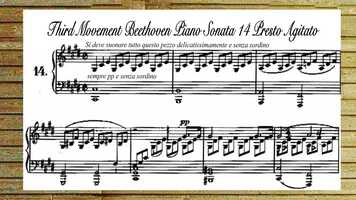
Beethoven instructed “Si deve suonare tutto questo
pezzo delicatissimamente e senza sordini” (the entire
piece should be played with the greatest delicacy
and without mutes). There is a direction between
the staves “semper pp e senza sordini” (play
“without mutes” with the dampers raised off of the
strings with the pedal down. In the same way, my
art work here is without muting, with the “pedal
to the metal”.
The stormy third movement is marked Presto
agitato. It is the weightiest of the movements.
With its fast arpeggios, strongly accented notes,
and fast alberti broken chord repeated arpeggiated
accompaniment, it demands lively and skillful
playing, and great stamina. It is “on speed/uppers”
and is more demanding than the first and second
movements.
Our modern pianos have a longer sustain time
than instruments of Beethoven's time. Beethoven's
sforzando and fortissimo passages are powerful,
and two hundred years after 1801, their ferocity is
astonishing.
As Beethoven's deafness increased with age,
is there anguish in his ferocity? The cause of his
hearing disorder, which could be treated today,
was otosclerosis, a disease of the bone around the
inner ear. It was sensori-neural hearing loss, a
degeneration of sensory cells in the inner ear.
Even in case of serious disease, new complex
hearing implants such as cochlear implants
could have helped Ludwig van Beethoven as
they helped deaf folks I knew decades ago.
As a testament to Lugwig's genius, his
sonata's third movement, is probably the
inspiration for Frédéric Chopin's Fantaisie
Impromptu as evidenced by the key relation-
ships of the sonata's three movements, chord
structures, and some shared passages, though
it is much more serene. The familiar Judy
Garland “I'm Always Chasing Rainbows”
interlude is followed by more drama. Below
is a link to Frédéric's Fantaisie:
youtube.com/watch?v=fBA-38mzabs
Download, play and edit free videos and free audios from Beethoven -Piano Sonata 14.mp4 using RedcoolMedia.net web apps